
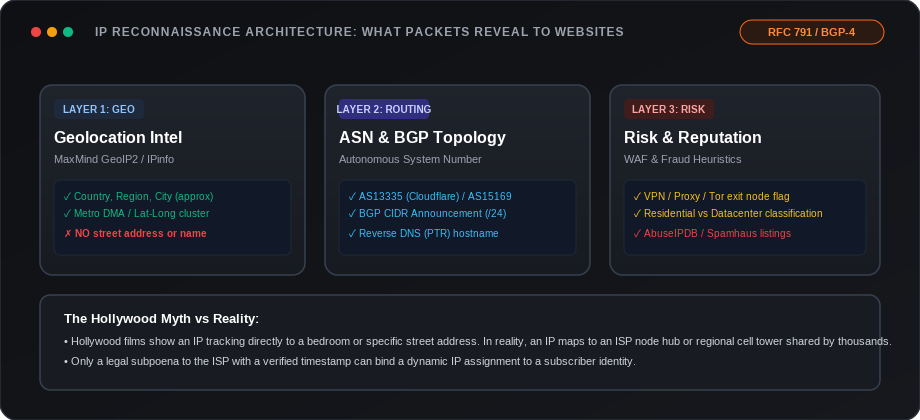
If you have watched a spy movie in the last two decades, you know the trope: an analyst taps a keyboard, shouts “I’ve got their IP address!”, and a blinking red dot locks onto an exact building floorplan.
As someone who builds network diagnostic tools daily, I still get asked whether sharing a public IP address exposes someone’s home street address or device identity. Here is what the TCP/IP and BGP routing protocols actually expose—and what requires much more than an IP packet.
Quick Verdict (TL;DR): A public IPv4 (
RFC 791) or IPv6 (RFC 8200) address reveals your ISP or hosting provider, Autonomous System Number (ASN), approximate city/metro geolocation, and whether the IP appears on DNSBL reputation lists—not your name, street address, or device identity. Audit your visible footprint with/tool/ipgeo,/tool/asn,/reverse-dns, andcurl/diglookups.
What an IP Address Actually Is (RFC 791 & RFC 8200)
An IP address is a logical routing label on a packet header—nothing more than the return address on a postcard so upstream routers know where to forward TCP/UDP replies. Under IPv4 (RFC 791) and IPv6 (RFC 8200), Regional Internet Registries (ARIN, RIPE NCC, APNIC, LACNIC, AFRINIC) allocate CIDR prefixes to ISPs and cloud providers, which advertise them via BGP (RFC 4271).
What Anyone Can See From Your Public IP
When your browser opens a TCP/HTTPS socket to a server, the remote host can look up public RDAP (RFC 7480), BGP routing, and geolocation telemetry via tools like our IP Geolocation & ASN mapper and ASN Lookup:
- Your ISP or Cloud ASN: The Autonomous System Number and network owner (e.g., Comcast, AT&T, Starlink, Cloudflare, AWS) from public WHOIS / RDAP and BGP routing tables—inspect any IP’s network in our ASN Lookup or WHOIS Lookup.
- Coarse Metro / City Location: Commercial MaxMind/IPinfo databases map CIDR prefixes to regional ISP PoPs or postal centroids—usually accurate to the city or metro region, occasionally wrong by hundreds of miles on mobile CGNAT carriers.
- Reverse DNS Hostname (
PTR): Many residential and server IPs publish anin-addr.arpaorip6.arpaPTRhostname (RFC 1035 / RFC 3596), such ascpe-xx-xx.nyc.res.rr.com, revealing the ISP market or mail server hostname. Check yours with our Reverse DNS Validator. - Abuse & Spam Reputation: Mail relays and WAFs immediately check whether your IP appears on DNSBL lists (RFC 5782) via services like our IP Blacklist Checker.
What They Cannot See From an IP Alone
Without a legal subpoena to your ISP’s subscriber DHCP/RADIUS/CGNAT accounting logs—or a compromised endpoint—no public IP lookup reveals:
- Your street address, apartment number, or GPS coordinates.
- Your legal name, phone number, or email address.
- Your OS login or hardware serial numbers.
CLI Check: Inspecting What Remote Servers See
Run curl and dig to inspect the exact public IP, reverse PTR, and BGP ASN origin exposed by your current connection:
# 1. Inspect the public IP and HTTP request headers seen by an external endpoint
curl -s https://ifconfig.me/all.json

# 2. Check TLS + CDN proxy headers returned by your edge host
curl -sI https://example.com | grep -iE 'server|cf-ray|x-forwarded|strict-transport'

# 3. Query Reverse DNS (PTR) and BGP ASN origin via Team Cymru DNS
dig -x 93.184.216.34 +short
dig 34.216.184.93.origin.asn.cymru.com TXT +short
Real Privacy Leaks Beyond Raw IP Addresses
An IP address alone rarely identifies a person, yet three real-world leaks tie sessions together:
- Browser Fingerprinting & Tracking: Trackers pair your IP with HTTP headers, TLS JA3/JA4 fingerprints, fonts, timezone, and screen metrics to track sessions even after clearing cookies.
- WebRTC STUN / ICE Leaks (RFC 8825): Even behind a browser proxy or misconfigured VPN, WebRTC peer discovery can expose your underlying ISP IPv4/IPv6 interface via STUN requests unless restricted.
- Forwarded Proxy Headers (RFC 7239): Misconfigured reverse proxies or corporate gateways sometimes leak internal LAN or client IPs inside
ForwardedorX-Forwarded-Forheaders. Inspect response security headers using our Security Headers Audit.
Practical Steps to Reduce Exposure
- Use a Reputable VPN or iCloud Private Relay: Routes traffic through shared egress nodes so destination servers log the relay’s ASN instead of your residential ISP.
- Disable or Restrict WebRTC IP Leakage: Configure browser privacy flags to force ICE candidates over the proxy route (
disable_non_proxied_udp). - Audit Your Egress Reputation: Run your server or home static IP through our IP Geolocation tool and IP Blacklist Checker if websites unexpectedly serve CAPTCHAs or SMTP connections reject mail.
Frequently Asked Questions
How accurate is IP geolocation for residential vs mobile vs VPN IPs?
Residential broadband IPs are typically accurate to the city or metro area (10–50 km radius) because databases map ISP broadband termination nodes. Mobile LTE/5G carriers use Carrier-Grade NAT (CGNAT), often placing your IP in a regional switching hub hundreds of miles away, while VPNs show only the exit data center.
Can someone trace my home street address from an IPv6 address?
No. Although IPv6 (RFC 8200) gives networks a /64 or /56 prefix, ISPs rotate prefixes and modern operating systems use RFC 8981 Temporary Address Extensions (Privacy Extensions) so outbound connections randomize interface identifiers rather than embedding your MAC address.
Why does my server IP reputation matter even if I don’t host a website?
Shared cloud and VPS subnets often inherit prior abuse history. If your server sends automated alerts, webhooks, or transactional emails from a dirty IP lacking a clean PTR record, recipients may block packets or reject mail with 550 5.7.1. Check egress health in our Reverse DNS Validator and IP Blacklist Checker.
Related Cluster Guides
- Reference: DNS Record Types Cheat Sheet (PTR, A, AAAA & RFCs)
- Outage Triage: My Go-To Checklist for Network Troubleshooting
- Email Blocking: How to Fix 550 5.7.1 Service Unavailable Error
Stay Ahead on Protocol Changes.
Get authoritative engineering deep dives on bulk sender requirements, post-quantum TLS, and RFC DNS standards directly in your inbox. Zero marketing fluff.
Maximum 1 dispatch per month · Unsubscribe with 1 click
Related tools
View all toolsWHOIS Record
Free WHOIS lookup. See the registrar, creation and expiry dates, status codes and nameservers for any domain, using the public RDAP service.
ASN / ISP
Free ASN lookup. Enter an IP or an AS number such as AS13335 to see the holder, country, announced prefixes and registry details.
Full Audit
Free full domain audit. One run checks DNS, email authentication, security headers, blacklists, ports and domain expiry, with a fix-first list.