
How DNSSEC Protects DNS Resolution
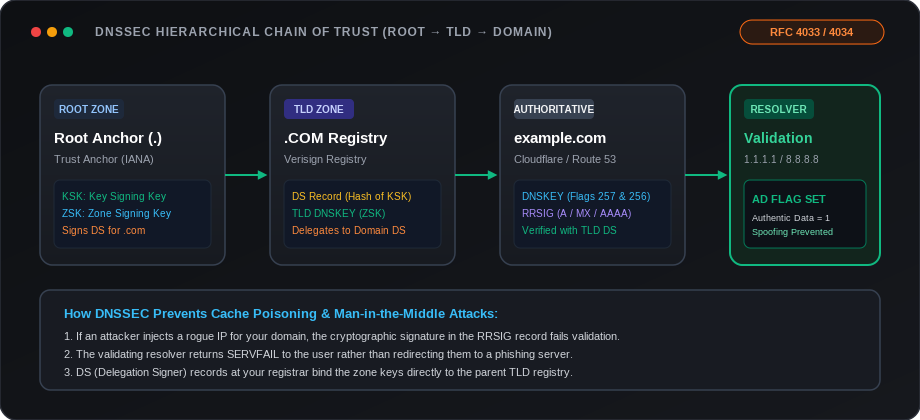
Standard DNS (RFC 1035) operates over unauthenticated UDP and TCP packets, leaving recursive resolvers vulnerable to on-path spoofing and Kaminsky-style cache poisoning. Domain Name System Security Extensions (DNSSEC) (RFC 4033, RFC 4034, and RFC 4035) eliminate blind trust by adding asymmetric cryptographic signatures to every DNS response so resolvers can verify that an answer came unmodified from the domain’s authoritative nameserver.
Quick Verdict (TL;DR): DNSSEC (
RFC 4033–4035) prevents DNS cache poisoning and BGP path spoofing by signing every authoritative zone record (RRSIG) with aDNSKEYhierarchy (ZSK/KSK) anchored to the parent zone’sDSdigest. Verify validation usingdig +dnssec(checking for theadflag) or/dnssec-checkerto catchBogusDS/DNSKEYmismatches before they trigger globalSERVFAILoutages.
The Cryptographic Core: How the Chain of Trust Works
DNSSEC does not encrypt DNS payloads (that is the role of DNS-over-HTTPS per RFC 8484 and DNS-over-TLS per RFC 7858); instead, it authenticates zone integrity through an unbroken cryptographic hierarchy anchored at the ICANN Root Zone Trust Anchor.
Authoritative zones split signing responsibilities across two DNSKEY records:
- Zone Signing Key (ZSK, flag
256): Signs individual resource record sets (A,AAAA,MX,TXT) inside your zone, producingRRSIGrecords. - Key Signing Key (KSK, flag
257): Signs theDNSKEYRRset itself. A cryptographic hash of the KSK is published in the parent TLD zone as a Delegation Signer (DS) record.
Modern deployments use Elliptic Curve signing algorithms defined in RFC 8624—most commonly Algorithm 13 (ECDSAP256SHA256) or Algorithm 15 (ED25519)—which yield short signatures that avoid UDP packet fragmentation compared to legacy RSA-2048 keys.
Common DNSSEC Misconfigurations That Cause Outages
When DNSSEC breaks, validating resolvers (1.1.1.1, 8.8.8.8, 9.9.9.9) do not fall back to unsigned resolution—they reject the tainted data and return SERVFAIL (RCODE 2), taking your site and email offline globally:
- Orphaned or Mismatched
DSRecords: Switching DNS providers (for instance, migrating between Route 53 and Cloudflare) without deleting or rotating theDSrecord at your domain registrar leaves a parentDShash pointing to an unknownDNSKEY. - Expired
RRSIGTimestamps: Misconfigured self-hosted BIND or Knot DNS signers fail to re-sign zone records beforeRRSIGexpiration, causing instant validation failures. - Incomplete Key Rollover: Retiring an old KSK or ZSK before cached
DS/DNSKEYTTLs expire breaks validation for resolvers holding older records (RFC 6781).
Command-Line Validation with dig and curl
Test any domain’s DNSSEC signature chain directly from your terminal using dig (+dnssec) and DoH (curl):
# 1. Check for the Authenticated Data (ad) flag on a validating resolver
dig @1.1.1.1 example.com A +dnssec +multi

# 2. Inspect the parent Delegation Signer (DS) record (key tag, algorithm, digest)
dig @1.1.1.1 example.com DS +short

# 3. Inspect child DNSKEY records (256 = ZSK, 257 = KSK) and RRSIG expiry
dig @1.1.1.1 example.com DNSKEY +dnssec +multi

# 4. Query DoH JSON to inspect AD boolean and RCODE Status (0=NOERROR, 2=SERVFAIL)
curl -sH 'accept: application/dns-json' 'https://cloudflare-dns.com/dns-query?name=example.com&type=A&do=1'
In dig output, look at the flags: header line:
flags: qr rd ra ad;-> AD (Authenticated Data) is present; the validating resolver verified the entire cryptographic chain from.(root) down to your apex.- Missing
adflag with validDSabsent -> Zone is Insecure (unsigned). status: SERVFAILwithdig +cd(Checking Disabled) succeeding -> The chain is Bogus (brokenDS/DNSKEY/RRSIG).
Instant Chain-of-Trust & Zone Diagnostics
Use our dedicated DNSSEC Chain-of-Trust Validator to audit every DS digest, KSK/ZSK key tag, algorithm compliance, and RRSIG expiration window from the ICANN root zone down to your domain. You can also inspect live DNSKEY, DS, A, and NS records right here or inside the DNS Zone Health Audit:
Network Diagnostic · DNS
DNS Lookup Records & Anycast Topology
A, AAAA, MX, TXT, NS and CNAME records. Direct edge diagnostics with zero caching and sub-second global resolution.
Protocol specsRFC
Validated against standard IETF protocol specifications.
- Direct Authoritative Query
- EDNS Client Subnet Support
- TTL Deviation Detection
- Apex CNAME Flattening Check
Edge POP routing12 active
Multi-region edge execution via anycast routing.
Remediation adviceRFC best practice
Actionable configuration guidance for infrastructure.
Always maintain at least two authoritative nameservers on different ASNs. Set TTL to 300s during migrations.
Interpreting DNSSEC Validation States (RFC 4035)
- Secure: Valid
DSin parent zone + matchingDNSKEY+ validRRSIG. Authenticated end-to-end. - Insecure: No
DSrecord published in the parent TLD zone. Data resolves normally without cryptographic proof. - Bogus: A
DSrecord exists in the parent zone, but signatures are missing, expired, or fail verification against the childDNSKEY. Validating resolvers returnSERVFAIL.
If you also enforce strict TLS certificate issuance alongside DNSSEC, pair your DS setup with a CAA record verified in our CAA Policy Checker.
Frequently Asked Questions
Does DNSSEC encrypt DNS queries like DoH or DoT?
No. DNSSEC provides data origin authentication and integrity—proving records weren’t tampered with—while leaving queries and responses readable in plaintext. Use DNS-over-HTTPS (RFC 8484) or DNS-over-TLS (RFC 7858) to encrypt traffic between clients and recursive resolvers.
Why does a broken DNSSEC DS record return SERVFAIL instead of falling back to unsigned DNS?
Falling back to unsigned answers whenever a signature fails would let an attacker strip signatures and downgrade victims silently. Per RFC 4035, a validating resolver MUST reject Bogus responses with SERVFAIL (RCODE 2) whenever a parent DS record promises the child zone is signed.
Which DNSSEC signing algorithms are recommended today (RFC 8624)?
RFC 8624 recommends Algorithm 13 (ECDSAP256SHA256) as the default standard for modern zones due to compact 64-byte signatures and universal resolver support, followed by Algorithm 15 (ED25519) and Algorithm 8 (RSASHA256) where legacy compatibility is required. Deprecated algorithms like RSASHA1 (5/7) should be rotated out.
Related Cluster Guides
- Cornerstone Reference: DNS Record Types Cheat Sheet & RFC Standards
- Zero-Downtime Cuts: DNS Migration Checklist (Handling DS Keys Safely)
- NXDOMAIN & SERVFAIL Triage: How to Fix DNS_PROBE_FINISHED_NXDOMAIN
- TTL & Caching: Why Does DNS Propagation Still Take So Long?
Stay Ahead on Protocol Changes.
Get authoritative engineering deep dives on bulk sender requirements, post-quantum TLS, and RFC DNS standards directly in your inbox. Zero marketing fluff.
Maximum 1 dispatch per month · Unsubscribe with 1 click
Related tools
View all toolsDNS Time Machine
Free DNS Time Machine. Track DNS record changes with git-style visual diffs (+/-) and export standard RFC 1035 BIND zone files for 1-click disaster recovery.
DNS Propagation
Free global DNS propagation checker. Query A, AAAA, CNAME, MX and TXT records across 12 edge locations with expected-value matching and Geo-DNS notes.
MTA-STS & TLS-RPT
Free MTA-STS and TLS-RPT validator. Audit policy files, verify _mta-sts DNS TXT records, and generate 1-click Cloudflare Worker and Nginx configurations.